
Topics covered in the Gdansk Scientific Meeting agenda
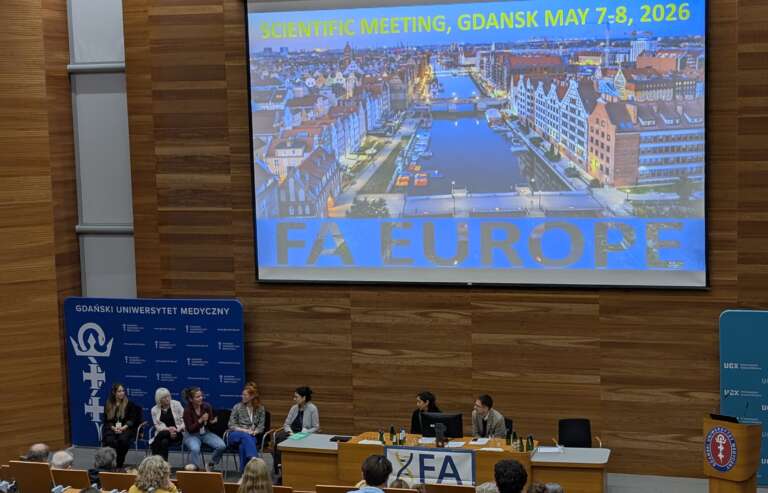
Across the two days of the Scientific Meeting, the meeting focused on the major clinical, biological, and cancer-related challenges of Fanconi anaemia, while also highlighting emerging treatments, long-term survivorship, and transition into adult care.
Main themes across the meeting
1. Stem cell transplantation and haematology
A major focus was improving outcomes from haematopoietic stem cell transplantation (HSCT), including:
- Long-term transplant outcomes
- Modern transplant conditioning approaches
- Prevention and treatment of graft-versus-host disease (GVHD)
- Bone marrow biology and clonal haematopoiesis
- Bone marrow microenvironment after transplantation
This reflects the continuing importance of HSCT as a life-saving treatment in FA, while recognising the need to reduce toxicity and improve long-term quality of life.
2. Cancer and cancer surveillance
Cancer prevention, monitoring, and treatment formed one of the strongest themes of the conference, particularly:
- Head and neck squamous cell carcinoma (HNSCC)
- Oral cavity lesions and oral carcinogenesis
- Tumour biology and tumour microenvironment
- Radiation sensitivity testing
- Brachytherapy experiences
- Drug repurposing approaches
- ENT surveillance programmes
- Molecular targets such as YAP/TAZ and USP28
The programme reflected growing concern about cancer as one of the major causes of illness and death in adults with FA.
3. New and emerging therapies
Several talks focused on future treatment strategies, including:
- Gene therapy
- Antisense oligonucleotide (ASO) therapies
- TRIDs and other pre-clinical therapies
- Targeted therapies
- Drug repurposing
- Precision medicine and genotype-driven approaches
This highlighted the field’s movement toward personalised and potentially less toxic treatments.
4. Biology of Fanconi anaemia
Day 2 especially explored the underlying biology of FA, including:
- Genotype–phenotype correlations
- Accelerated ageing and immune ageing
- Epigenetics and methylation
- DNA damage pathways
- Genomic instability
- Phenotypic diversity
- Metabolic causes of DNA damage
These sessions aimed to better understand why FA presents so differently between patients and how biological pathways might be therapeutically targeted.
5. Transition to adulthood and lifelong care
An important clinical and social theme was transition from paediatric to adult services, with national models presented from:
- Germany
- Italy
- Poland
- Spain
- The Netherlands
- The UK (poster only)
This recognised the increasing adult FA population and the need for structured adult multidisciplinary care.
6. Patient experience and quality of life
The programme also included broader patient-centred themes such as:
- Fertility and family building
- Long-term survivorship
- Patient life stories – in particular, a talk by Matthew Farrow, the world’s first cord blood transplant recipient
- Quality of life after transplant
- Oral mucositis management
7. Flash Talks and Posters
To encourage newer researchers in particular, a series of 13 Flash Talks and/or poster presentations were included in the programme. These covered a wide range of topics, including:
- Genotype-Phenotype Stratification in FA-D1: Patients with biallelic BRCA2 alterations (FA-D1) face an exceptionally high risk of early-onset malignancies, with cumulative incidence reaching 82.9% by age 10. Cancer, rather than bone marrow failure, is the predominant phenotype in this group. While standard mitomycin-C tests on lymphocytes often fail to show characteristic cell-cycle arrest, fibroblast-based functional diagnostics are highly consistent in confirming the diagnosis.
- Novel Therapeutic Targets for Squamous Cell Carcinoma (SCC): Because FA patients are hypersensitive to traditional DNA-damaging therapies, research is focused on non-genotoxic targets. Promising targets include the USP28 and YAP/TAZ signalling pathways, which are overexpressed in FA-associated SCC and promote tumour proliferation. Combining inhibitors, such as those targeting USP28 and EGFR, has shown synergistic lethal effects in specific FA-SCC cell lines.
- Development of Preclinical Models: Researchers have established unique mouse and cellular models, including Fanca-KO mice, that faithfully recapitulate the spectrum of oral carcinogenesis from early lesions to invasive carcinoma. These models provide a platform for testing early intervention strategies and investigating the molecular mechanisms driving malignant transformation.
- Structured Surveillance and Registry Insights: Evidence from the UK registry indicates that regular surveillance in specialised FA clinics leads to higher detection rates of early-stage tumours, particularly for anogenital SCC. The ongoing FAN-SCOPE study highlights the feasibility of structured ENT programs using bioendoscopy and cytology for the early detection of suspicious mucosal lesions.
- Genomic Instability and Accelerated Aging: FA is characterised by perturbed DNA methylation patterns in peripheral blood cells, providing the first quantification of accelerated aging in these patients. Studies mapping genomic breakpoints in bone marrow aim to determine if chromosomal aberrations are due to fragility at specific genomic sites or positive selection during clonal expansion.
- Emerging Personalised Therapies: Antisense oligonucleotides (ASOs) are being explored as a personalised “N-of-1” approach to correct specific splicing mutations in FANCA. If successful, this approach could potentially block disease progression and delay or prevent the onset of associated tumours.
- Biomarkers of Oxidative Stress: FA patients demonstrate a dysfunctional antioxidant response in red blood cells, characterised by an initial adaptive increase in enzyme activities (GSTP1, GPx) that collapses under high oxidative stress. These impaired responses may serve as novel endotype biomarkers for the disease.
- Fertility and Family Building: FA is associated with primary ovarian insufficiency and reduced sperm production, yet knowledge gaps remain regarding actual fertility rates and the use of assisted reproductive technologies. An international questionnaire study aims to provide evidence-based reproductive counselling and clarify the best timing for such interventions.
This gave the meeting a balance between laboratory science, clinical medicine, and lived experience.
Overall, the two days presented a highly integrated picture of Fanconi anaemia research and care — spanning transplantation, cancer, genetics, ageing, emerging therapies, survivorship, and international models of adult care.